The next wave of AI adoption isn't coming from big companies
June 24, 2026

We're back with some thoughts on the AI space and how it impacts our community here at Quin.
The assumption has always been that enterprise moves first and small businesses eventually catch up. Big budgets, dedicated teams, innovation labs. That's been the pattern with every major technology shift for the last few decades.
With AI, I think it's flipping.
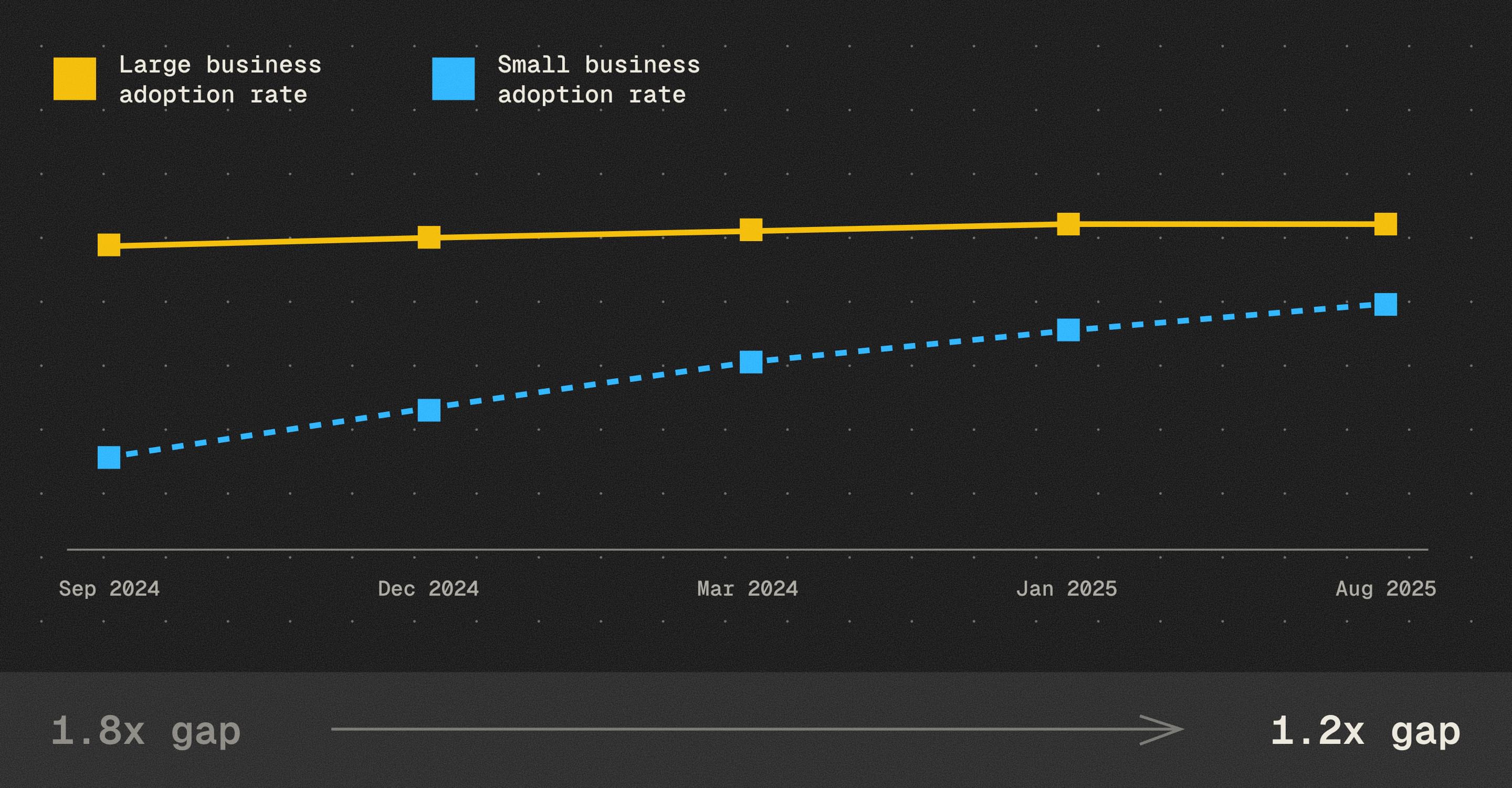
The SBA published research last September that makes this pretty clear. In early 2024, large businesses were using AI at 1.8 times the rate of small businesses. By August 2025, that gap had dropped to 1.2x. The broadband adoption gap between large and small businesses took nearly a decade to close. The AI gap is closing in quarters.
The reason isn't that small businesses got more sophisticated. It's that they can move without asking anyone's permission. A large company adopting AI has to get through procurement, IT approvals, security reviews, and change management before anyone actually uses the thing.
Alternatively, small businesses feel a problem, find something that solves it, and start using it the same week. That speed advantage is real, and it doesn't show up in any enterprise AI budget report.
There's also something more direct about the cost of inefficiency when you're running your own practice. When you're the CEO, the advisor, the marketer, and the admin all in one day, wasted time isn't a line item somewhere - it's your entire evening. That produces a specific kind of urgency that's hard to replicate inside a large organization where the pain is distributed across departments and nobody feels it personally.
Here’s the structural implication...
Professional services has always been a headcount equation. You can only serve as many clients as your hours allow. The operational layer (all that work around the work) puts a ceiling on what any one person can do. When that layer starts running on its own, the ceiling moves. A solo advisor can take on more clients. A small firm can operate like a larger one. That's not a marginal efficiency gain, it's a different model entirely.
The Fortune 500 will get there. They always do. But the window where independent professionals and small firms have a genuine speed advantage over their larger competition is right now, while the bigger players are still in committee deciding whether to run a pilot.
A question worth thinking about this week:
Is the ceiling in your practice actually a headcount problem, or is it a time problem that more people wouldn't fully solve?
#skills