Build the seat before you pick who sits in it
November 10, 2026
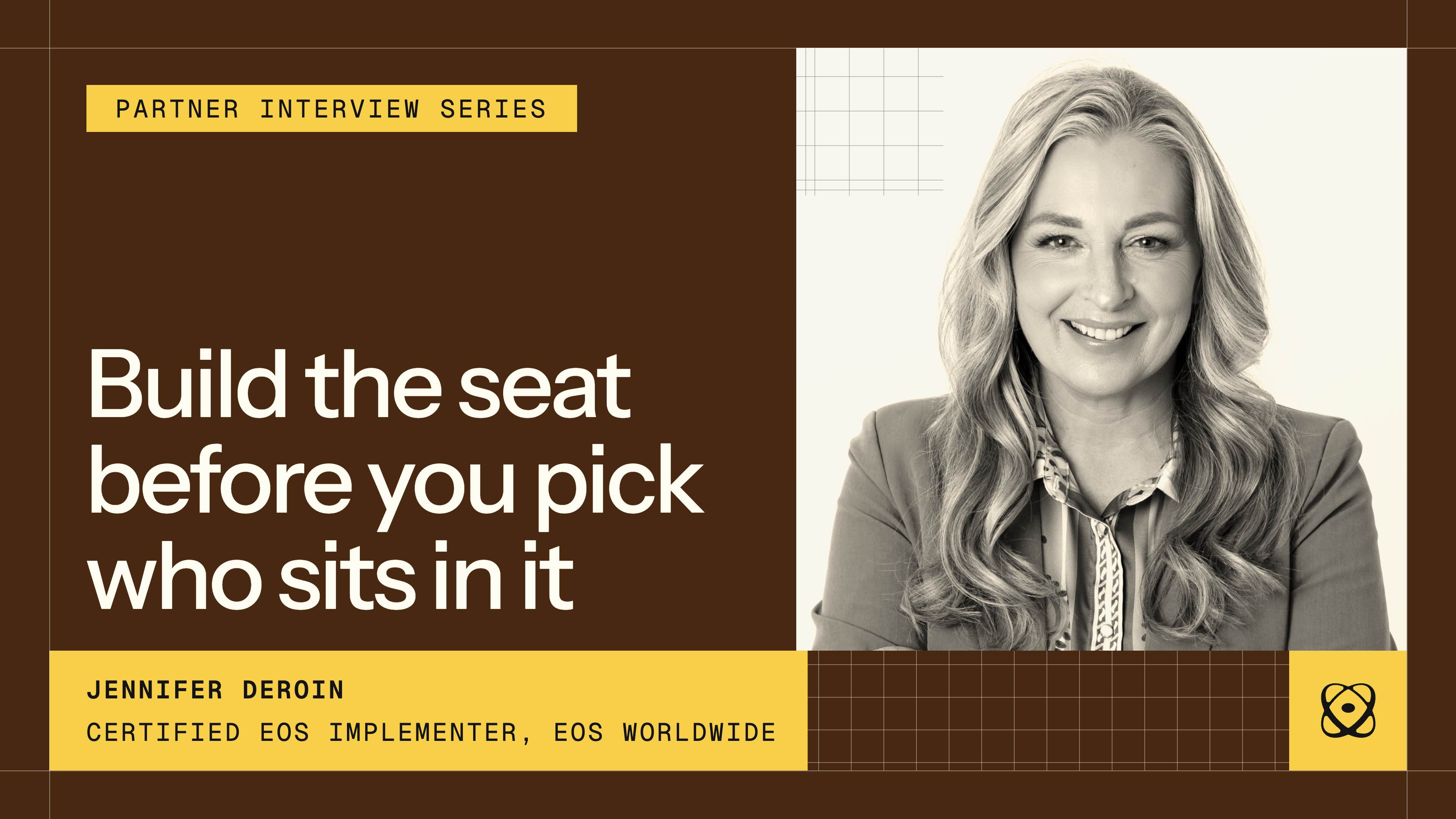
This is the latest installment of our Partner Interview Series, where Gabe sits down with the people who help advisors and sales teams run their business, and gets into where AI fits into that today.
Next up is Jennifer Deroin, a Certified EOS Implementer with EOS Worldwide, based in Boise, Idaho. Jennifer spent 20+ years in commercial banking and then scaled a public accounting firm, which is where she discovered EOS. She ran it in her own firm first, then turned it into her full-time practice. Today she helps leadership teams put the system Gino Wickman laid out in Traction to work.
What does an EOS Implementer actually do, and what is EOS?
At the end of the day, our ultimate goal is we want to help people get what they want from their business. Period. And we do that by helping them implement a proven system, full of practical tools. There's no silver bullet, no magic pills. They're time-tested principles and tools that we know work, and the beauty of what Gino Wickman did is he took a lot of those principles and put them into one holistic system.
EOS stands for the Entrepreneurial Operating System, and it's effectively a methodology, an operating system with which to run your business. What we want to do is help leadership teams get stronger in three things we call vision, traction, and healthy. Vision, we're helping the leadership team get clarity and alignment on where they're going as an organization and what their plan is to get there. Traction, we're helping them instill discipline and accountability so they can execute on that vision. And healthy, we're trying to help them be a cohesive, fun-loving, honest team. As goes the leadership team, goes the rest of the organization. Everybody sees the vision, they see themselves in it, and everybody's rowing together.
My role in that process has three parts. First, I'm a teacher, teaching them about EOS, giving them context to deepen their understanding of the disciplines and tools. Second, I'm a facilitator, helping them get to their best answer. I'm not showing up as a consultant with all the answers; we believe the wisdom is in the room, they know their business best, and we're here to help them unlock it. Third, I'm a coach, helping them see how they're showing up in this game of business, which sometimes looks like giving them feedback on what they need to hear, not what they want to hear.
Who's your ideal client? Is there a specific industry you focus on?
It's an operating system, and every business needs one, so it's really industry agnostic. EOS was built for entrepreneurial leadership teams with 10 to 250 people in the company. It's best for teams that are growth oriented, teams that are maybe more afraid of the status quo than they are of change, and we want to work with leaders who are willing to be open, honest, and vulnerable with themselves and with others. There are companies that run on EOS smaller than that range and bigger than that range, but that's our sweet spot.
Most people in our community are financial advisors who effectively run their own businesses. Have you worked with advisory firms, and is EOS something they could learn from?
Most certainly. There are a lot of wealth management and financial advisory organizations running on EOS and getting great results. I tell leaders, if you want to grow and you have people in your organization, EOS will help you. You asked me about industry-specific things, and the one thing I've learned is that people are people everywhere you go. They all want clarity around where we're headed. They want clarity on what success in their seat looks like, and how they win at work every week. They want feedback on how they're doing. They want a voice, to be able to speak into things that are important to them. I find those attributes are true everywhere, and EOS gives them a framework for checking all of those boxes and more. Our human nature is that we want to belong to something that matters, we want to understand how to win at work, and we want to play a part in bringing the organization forward together. This gives people a framework for doing that simply, in a way that can be internalized throughout the organization.
What are the frustrations you hear most often from leaders who come to you?
There are five frustrations we've identified. A leader comes to us and says, I'm feeling stuck, I feel like I'm hitting a ceiling. That can look different for different people. In my prior life, I had very high top-line growth, but from our bottom line, I felt stuck. Stuck can feel like a frustration around getting people aligned and rowing in the same direction, or getting the results you think you should be getting.
The number one frustration they'll quote is around people: my employees aren't doing this, my customers, my vendor, whatever it is. 82% of their frustrations are tied to people. The second most common frustration we hear about is profit. And to be clear, not enough of it. We also hear that the business is running them instead of them running the business. And then there's the feeling that everything they try is flavor of the month, that nothing's working. Of those, the two that stand out most are people, and the business running them instead of them running the business.
Let's dig into the business running them. If someone's working 60 hours a week, how do you coach them to carve out time to work on the business instead of in it?
When people tell me they feel stuck, one of the ways that shows up is time capacity: I don't have freedom of my time. There are four freedoms people want, and freedom of time is one of them.
The first shift is a mindset around understanding that we need to build infrastructure, create extensions of ourselves. Think about that founder when they started the company. They're running and gunning, and they hit the ceiling because they've become the bottleneck. They're making all the decisions, they're the fixer of everything, everybody's coming to them. So they have to learn to begin creating extensions of themselves and building a leadership team. This shows up especially in financial services, or really anywhere in the professional-service world where you're a subject-matter expert: financial advisor, accountant, attorney, engineer. There's a process of learning to delegate to others and changing the belief that I can do it faster, I can do it better, nobody can do this as good as me. That thinking keeps people trapped and limits their growth.
It starts with a discovery: if I want to 10x this company, I'm going to have to change my thinking about what's required to do that. When we set that first 10-year target with a team, I watch two very distinct responses. For some people it's invigorating and compelling. Others look at it and think they'll have to work ten times harder. Actually, the reverse is true. You need to build that infrastructure, and you're eventually going to let go of some of the in-the-business things you're doing and delegate them to people who do them as good or better than you, which is hard to imagine at the beginning, because when we built the business, we sat in all the seats.
From there, we give them tools for getting clear on what success in a seat looks like. The second tool is our time management tool. This is an evergreen issue. It never fully goes away, you just keep evolving. We walk people through a delegate-and-elevate exercise, learning to let go of things they're good at but that aren't their unique ability. Unique ability is: I love to do this, and I'm great at it. Versus: I don't want to do this, but I'm good at it because the business forced me to get good at it. My goal for any leader I work with is that they're spending 80% of their time living in their unique ability. But letting go of the rest is a mindset shift, and it's a trust thing.
I usually tell leaders, you're not doing $20-an-hour work. List out everything you're doing that's $20-an-hour work. Delegate and elevate breaks your work into four quadrants, and the one people have the hardest time letting go of is the work they don't like to do but are good at, because they think they're the only one who can do it. But when you're hanging out there, you're actually costing the company money, and you're not acting in the mindset of what the greater good of the organization needs from you. Gino Wickman talks about this in Shine, and Dan Sullivan and Benjamin Hardy get at the same idea in 10x Is Easier Than 2x and Who Not How. It's a journey.
Why do people hang onto work they know they should delegate?
I think there are a few things going on, but the most common, particularly in what we call the visionary seat, is: who am I in this organization if I'm not the person who does that? They've placed their value on being that person. It's what they know, they're comfortable there, and they can't imagine what the world looks like if they're not doing the tangible tasks they understand. Management is doing work. Leadership is thinking work. So the work is getting them to give themselves some white space to actually think, create clarity and confidence, and see out three years instead of looking down and in. Doing work has a tangibility they're familiar with, and when human beings get uncomfortable, we gravitate back to what we know instead of stretching into something new.
It sounds obvious, but it's an emotional issue, and a lot of times we throw logic at an emotional issue. They have to emotionally process letting go and see something else in their future. There's also a delegation curve. People generally aren't great delegators. I picture it as a bell curve: there's learning, learning, learning, a mistake. And that's exactly when I see leaders swoop in and take it back, before the person is past the learning cycle. One of the visionaries I worked with described it as being on the field playing ball. Somebody missed a hit to shortstop, and she said, all right, everybody, you're all on the bench, give me the ball, I'm going in. What we see there is nervousness. There are two things going on there: the uncomfortableness of stretching into something new, and the fear of what might happen when you let go without setting the right infrastructure in place to set that person up for success.
EOS has six key components. Where do technology and AI fit in when you're building out a team?
We help teams get stronger in six key components: vision, people, data, issues, process, and traction. On the people component, we talk about right people in the right seats, terms Jim Collins popularized. A lot of people throw those terms around, but EOS was the first time we got real clarity and shared language and tools for discerning what that actually means. The first tool is the People Analyzer. Right people means core-value fit, right seat means they're genetically encoded to do the job to some degree: they love the work, and they have the skill, ability, and time to do it.
The second tool is the Accountability Chart. It's similar to an org chart, but instead of hierarchy and positions, we look at functions: what business function is needed for the work to get executed? We build that out starting with the leadership team, and only after we've defined the correct structure do we ask who's the best person to sit in each seat. That might be a leader, a mid-level manager, an entry-level worker. It might be an AI agent. We want to remove the emotional decisions that often drive this, like: well, Susan's sitting in the room, let's build a job around Susan. No, we're going to build a structure the business requires, and then we're going to put those people into those seats, whether they're human or technology.
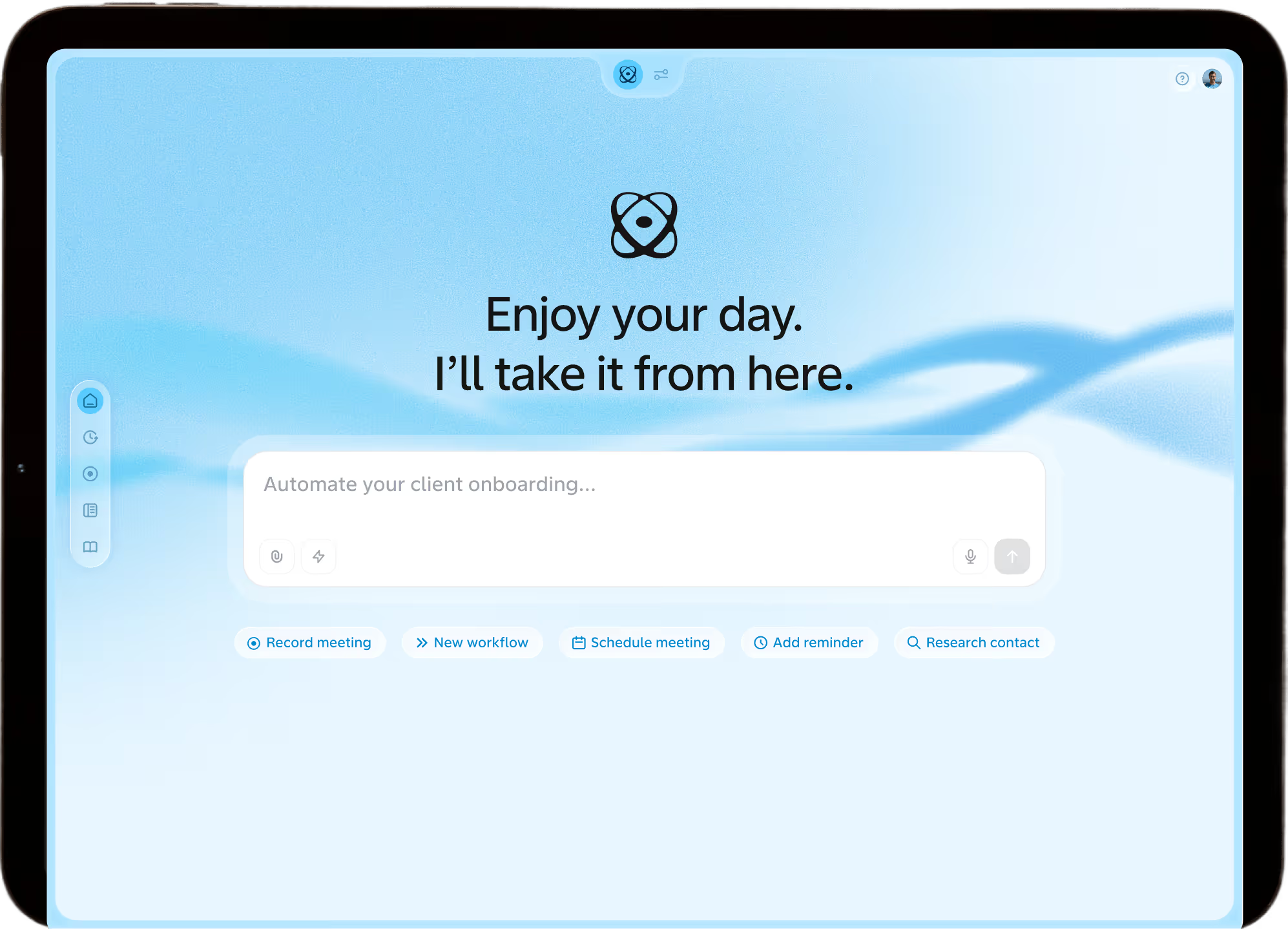
AI agents can work like teammates now. If a tool like Quin can do an advisor's admin work accurately for a fraction of what a staff member costs, is it a no-brainer to put it in that seat?
Yeah, absolutely. They have to walk through and make the decision: what's the best fit for this seat? Maybe I have an assistant who helps me do higher-level tasks, and now that assistant can delegate and elevate too. When we talk about AI, I think most people are asking, how do I rise up, do more, and live into a higher value, a higher offering? So whether I'm replacing a human with technology or amplifying a human with that technology, can they delegate and elevate the things they don't love to do, but are good at, to a solution that has a lower cost and is very efficient? And now what are they freed up to do? Who else in the organization can make that transformation, 10x their output, and live in their love-and-great quadrant? All of that should be factored in. Who's the right who for this seat: a human, or a technology? And how do I help every person in the organization elevate and do their best work?
Advisors spend a lot of time on admin: taking notes, entering data, filling out forms, sending emails and proactive check-ins. Using your framework, what should they look at delegating first?
Almost everything you just listed. There's very few people that think, man, I love filling out these forms, I love entering all this data into my CRM, I love sending all these emails. Maybe they like it and they're good at it, or they don't like it but they're good at it. Either way, those are the repetitive tasks where we can remove a lot of the steps using AI, automated workflows, whatever it is, in the background.
Then the question is, what has that now opened up as a possibility? I'd bet any financial advisor would say they could use more face-to-face time connecting and creating better relationships with the clients they serve, more time to create wow experiences that delight the people they work with. Instead they're bogged down in paperwork and data entry. Whatever they can delegate to automation or AI frees up that time for more human connection, which is what honestly accelerates that business.
Favorite book, favorite tool, and how do you take your coffee?
Well, obviously I give out Traction like it's candy. But of the many great business books, I doubled down a lot on The Five Dysfunctions of a Team, because of team health. When teams are healthy, I watch them just go, and when they're not, it is so, so painful. That book gives you a framework for talking about what something like trust actually means, and I don't think teams can focus on that enough. Outside of business books, one of my favorites is The Boys in the Boat, about a crew team. I like to read, but this one is a great listen. The narrator makes it really entertaining.
My favorite AI tool is Claude. Here's a fun way I used it recently. I was speaking at the EOS conference, so I set up a project and had Claude act as my speaking coach. It helped me build my content and get it exactly the way I wanted it. Then I'd record myself rehearsing on my Plaud recorder and upload the audio so Claude could give me feedback. That's not something I even thought about early on, but it was really fun, and since I do a fair amount of speaking, I'll keep using it that way.
And I take my coffee black, with one packet of stevia. I'm a simpleton, I brew at home. Most days it's a K-cup, currently Starbucks caramel, though I do have one of those little grinder machines too.
The idea we keep coming back to from this conversation: the hardest work to hand off is usually the work we've tied our identity to. That holds whether or not your firm runs on EOS. If you want to talk with Jennifer about getting your leadership team unstuck, you can find her at EOS Worldwide or connect with her on LinkedIn.
#skills